
How Home Assistant Fits Into My Home
Home Assistant is the front door to the system, not the place every service has to live.
All I wanted was…
to turn the lights off without getting out of bed.
Then it escalated quickly.
It started with the lights
The original requirement was not ambitious: turn the lights off without getting out of bed. That turned into Home Assistant, then a few supporting services, then a home-infrastructure project worth keeping track of.
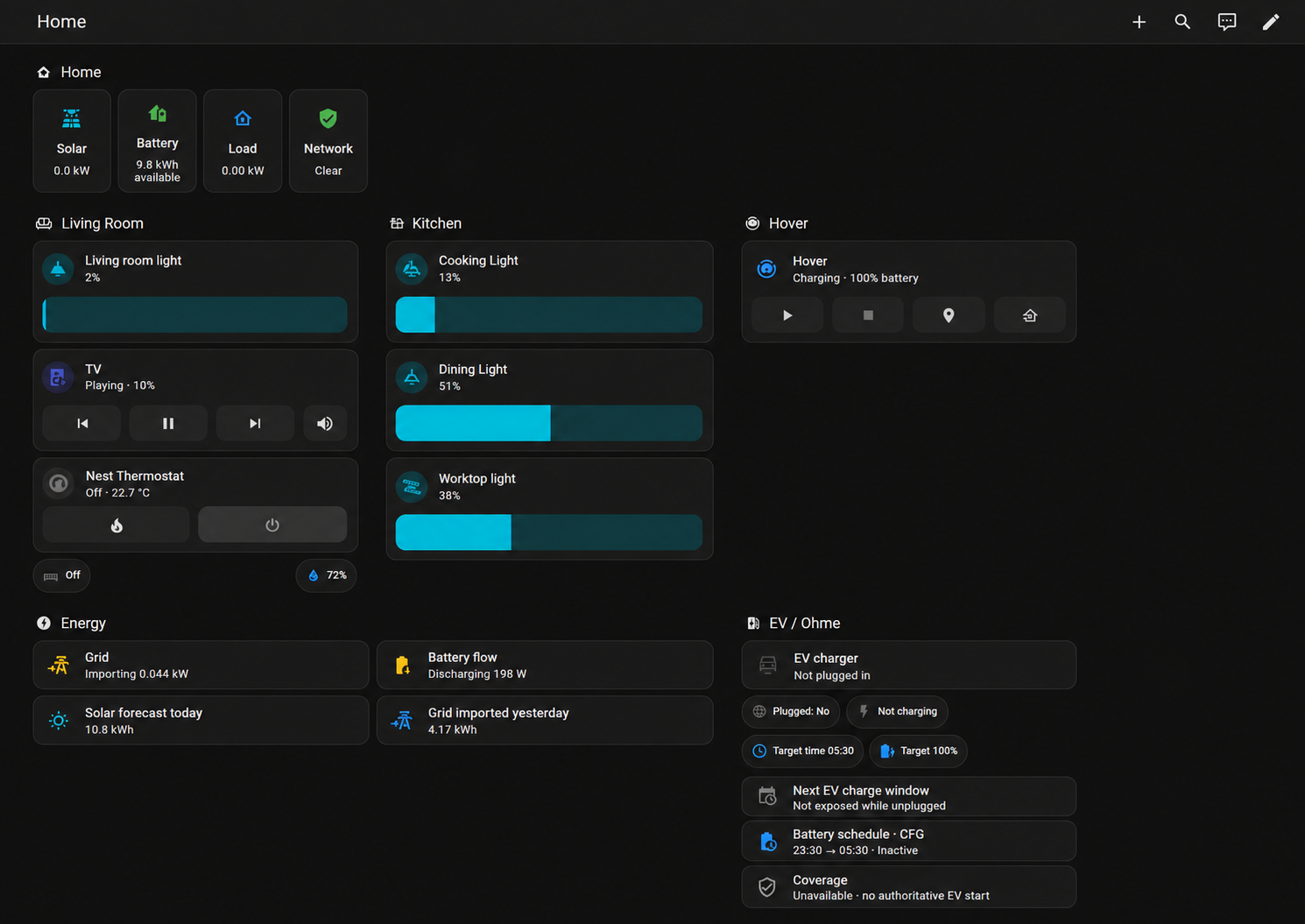
Home Assistant brings together climate, lighting, energy, media and household integrations. It is the useful front door, not a place to hide every other service.
Architecture
The platform runs as one virtualised service alongside DNS, energy history, climate history, proxy and resilience components. Keeping them separate means a dashboard problem does not automatically become a database, network or backup problem. Home Assistant provides the views, integrations and automations; it is not the source of truth for every subsystem.
Dashboards use a sections-based layout and retain useful controls close to the rooms and systems they describe. The implementation favours existing integrations and native entity controls over custom control paths.
Engineering choices
Two rules have proved useful: look before changing, and make notes as I go. Most of the system reuses kit already in the house; when something new is needed, it should be practical hardware that earns its place rather than the most expensive answer. Spend money where it makes a difference, reuse perfectly good hardware elsewhere. The value is in making the parts work well together.
Changes use existing entities and supported integration interfaces. When a control cannot confirm a physical result, the UI and automation should not pretend otherwise.
The same common sense applies to a healthy dashboard: it tells me what it can see at the time, not that every part of the house has been watched forever.
Where it stands
Home Assistant is now the day-to-day front door for the house: lighting, heating, energy and the other systems meet there without having to become one giant service. A few recovery and resilience jobs are still on the list, which is normal for a home system that keeps evolving.
The point
Home Assistant is where the systems meet, not a reason to collapse them into one giant system. Clear boundaries and honest notes have been more useful than another dashboard card.